In birth chart, the North and South Nodes always appear simultaneously, forming an opposition, and they are always a pair. They represent opposite meanings: one represents habits, and the other represents growth goals and the desire to develop. Whether in a synastry chart, composite chart, midpoint chart, time chart, transit chart, secondary progression chart, solar arc, etc., whenever the North Node appears, the South Node will also appear simultaneously, and they will always be in opposition.
The modern significance of the North and South nodes
The North Node is also known as the Dragon Head. In India, it is called Rahu, and in China, it is called Luohou. In classical astrological literature, it is referred to as North Node/Ascending Node or Head of the Dragon.
The South Node is also known as the Dragon’s Tail. In India, it is called Ketu, and in China, it is called Jidu. In classical astrological literature, it is referred to as South Node/Ascending Node or Tail of the Dragon.
As is well known, the North Node and South Node are virtual points, not actual celestial bodies. The North and South Nodes are the two points where the Moon’s orbit intersects the Earth’s (Sun’s) orbit, one in the north and one in the south. These two points are always 180° apart; that is, if the North Node is located at 0°30′ Aries, then the South Node will be located at 0°30′ Libra.
The North and South Nodes have seen significant development in modern astrology, influenced by Indian astrology and reincarnation astrology, and these two nodes have been given special significance.
For example, the North Node is considered to be our future life, representing the direction of our soul in this life and the lessons we need to learn in this life; while the South Node is considered to be our past life, representing the karma of our soul in previous lives and the habits we need to overcome and change.
In astrology, the North and South Nodes represent past and present lives. The North Node represents the goals of spiritual growth in this life, while the South Node represents unfinished lessons from past lives. When they appear on a person’s birth chart and form aspects with their planets, it means that this person will act in accordance with the energy of that planet in matters related to the North and South Nodes. The sign in which the North and South Nodes fall will use their energy to handle matters governed by that sign. Depending on the house they fall in, the energy of the North and South Nodes will be used to handle events related to that house. A brief explanation of the North Node and South Node in astronomy
1. The Earth’s orbit around the Sun is called the ecliptic plane, and the two points where the ecliptic plane intersects the Moon’s orbit are called the North and South nodes.
2. The ecliptic plane is usually the plane of Earth’s orbit, and also the plane of Earth’s revolution around the Sun. However, most celestial bodies outside of Earth in the solar system do not orbit in equilibrium with Earth’s orbit. But they will intersect the ecliptic plane at two points, one half above the ecliptic plane and the other half below it. These two points are called the ascending node and the descending node.
3. The North Node is the Ascending Node, and the South Node is the Descending Node. This means that a planet moving from north to south will have its Descending Node, and moving from south to north will have its Ascending Node. When a planet reaches its Ascending Node, it will orbit above the ecliptic plane. When it reaches its Descending Node, it will orbit below the ecliptic plane. The Moon follows the same principle. When the Moon reaches its Ascending Node, it is called the North Node, and when it reaches its Descending Node, it is called the South Node. The image below is a diagram of the Moon’s North and South Nodes that I created. It’s not perfectly standardized, but it’s good enough if you can understand it.
Moon’s North and South Node Symbols
The lunar nodes are the points where the Earth’s orbit around the Sun and the Moon’s orbit around the Earth intersect, forming the North Node and South Node. The symbols for the North and South Nodes resemble headphones, but they are always opposite: the North Node’s headphone jack points downwards, while the South Node’s points upwards. Furthermore, the North and South Nodes are always opposites, representing opposing meanings and connotations: the South Node represents conservatism, while the North Node represents development.
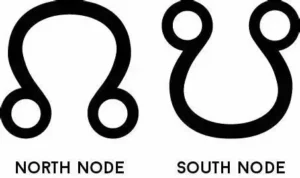
South node symbol North node symbol
The influence of lunar nodes on us
In astrology, the Moon’s North and South Nodes represent karmic connections from past lives. The South Node signifies unfinished lessons from a past life, while the North Node represents the direction of growth needed in this life—its spiritual goals. Essentially, the North and South Nodes encapsulate both past and present lives. Below, I will share keywords related to the North and South Nodes and their meanings.
1. North Node
Keywords: sense of accomplishment, aspiration, direction, growth, evolution, change, moving forward, learning to trust, new experiences, risk-taking, untapped talent, unfamiliar territory, potential, purpose, law.
From these keywords, it becomes clear that the North Node represents areas of future spiritual growth that are still unfamiliar and largely unexplored. It points toward aspirations, forward movement, and the courage to take risks, even when the outcome is uncertain. The path of the North Node often feels uncomfortable at first, as it requires stepping beyond habitual patterns and trusting experiences that lie outside one’s comfort zone.
In astrology, the North Node is generally regarded as auspicious in nature, similar to benefic planets such as Venus and Jupiter. However, its positivity does not come effortlessly. Instead, it represents growth through challenge, learning, and conscious choice. The North Node also symbolizes innate but underdeveloped talents—abilities that exist as potential rather than mastery.
Ultimately, the North Node reflects the sense of fulfillment gained through innovation, self-improvement, and personal evolution. It encourages individuals to embrace change, develop new skills, and reshape their life direction in alignment with higher purpose and natural law.
2. South Node
Keywords: sense of security, habit, familiarity, guarantee, caution, resistance to change, stagnation, comfort zone, boredom, defense mechanism, past experience, mechanical behavior, mastery, completion, karma.
Using these keywords, the South Node represents patterns that feel safe, familiar, and instinctive. It reflects a strong sense of security rooted in past experience, habits, and behaviors that once guaranteed stability. The South Node shows areas of life where mastery has already been achieved, often leading to mechanical or automatic responses. While this placement offers comfort and competence, it can also create stagnation, boredom, and resistance to change. Acting cautiously or refusing to move beyond what is known becomes a natural defense mechanism. In astrological interpretation, the South Node symbolizes completed lessons and accumulated karma, often drawing a person back to old roles, familiar environments, or emotional “home base.” Although it provides grounding and survival skills, overreliance on the South Node can keep an individual stuck in patterns that no longer support growth, making conscious evolution necessary.
Sentences using keywords from the South China Sea
The South Node signifies a strong emphasis on security and a reliance on the present. Anything desired must be reliable and stable, and any attempt to improve familiar things requires caution. While desiring improvement, the South Node is unwilling to innovate or take risks to change, preferring to proceed cautiously, ensuring security while remaining accustomed to routine. When change is truly necessary, the South Node resists, becoming stuck in familiar habits that may involve arguments and struggles. This weariness leads to heightened defenses, a focus on security and the old ways, ultimately returning to home base and making it difficult to change the current predicament. This series of behaviors by the South Node resembles mechanical actions, repeatedly revolving around familiar routines. It’s quite possible to spend a lifetime completing tasks that are only done once a day. The South Node also learns and masters things; once learned, these skills are unchanging, naturally becoming habits. This means the South Node spends their life doing the same things repeatedly—people they knew in past lives, still doing them in this life – this is karma.
From the sentences constructed above, the South Node, simply put, represents habit, a focus on old things and security, and a reluctance to change or innovate. These habits prevent new achievements and growth. Furthermore, the familiar things associated with this node are memories left over from past lives, and in this life, one tends to act based on past experiences. Because the final keyword is karma, which represents the cycle of reincarnation, or what people call karmic obstacles, the South Node is considered inauspicious, much like Saturn, bringing limitations and troubles.
Law and Karma: The North and South Nodes of the Moon
Finally, one more essential point should be added. A key concept associated with the North Node is Dharma, while the South Node is closely connected with Karma. These two principles are deeply interconnected and cannot be understood separately. Karma represents accumulated patterns, habits, and experiences carried over from the past, while Dharma reflects the path of growth, responsibility, and conscious development in the present life.
This relationship suggests that unresolved karmic patterns of the South Node cannot be transformed by repeating old behaviors. Instead, balance is achieved by consciously moving toward the qualities and lessons of the North Node. When a person actively follows their North Node path, they gradually reshape and heal the karma associated with the South Node.
In this sense, the lunar nodes function as a dynamic balancing system rather than opposing forces. The South Node shows what feels familiar and instinctive, while the North Node challenges the individual to evolve beyond comfort zones. Through this ongoing interaction, the law of karma becomes a tool for spiritual growth, guiding the soul toward greater awareness, purpose, and inner alignment.